

S.M. Wires delivers high-quality ferrous and non-ferrous wires nationwide, trusted by leading OEMs across India.

Scrap to Steel Billet Process

The journey of steel manufacturing begins not from raw ores but from recycled scrap, contributing to environmental sustainability and cost efficiency. This phase of the steelmaking process converts old metal scrap into high-quality steel billets, the foundational material for various steel products.
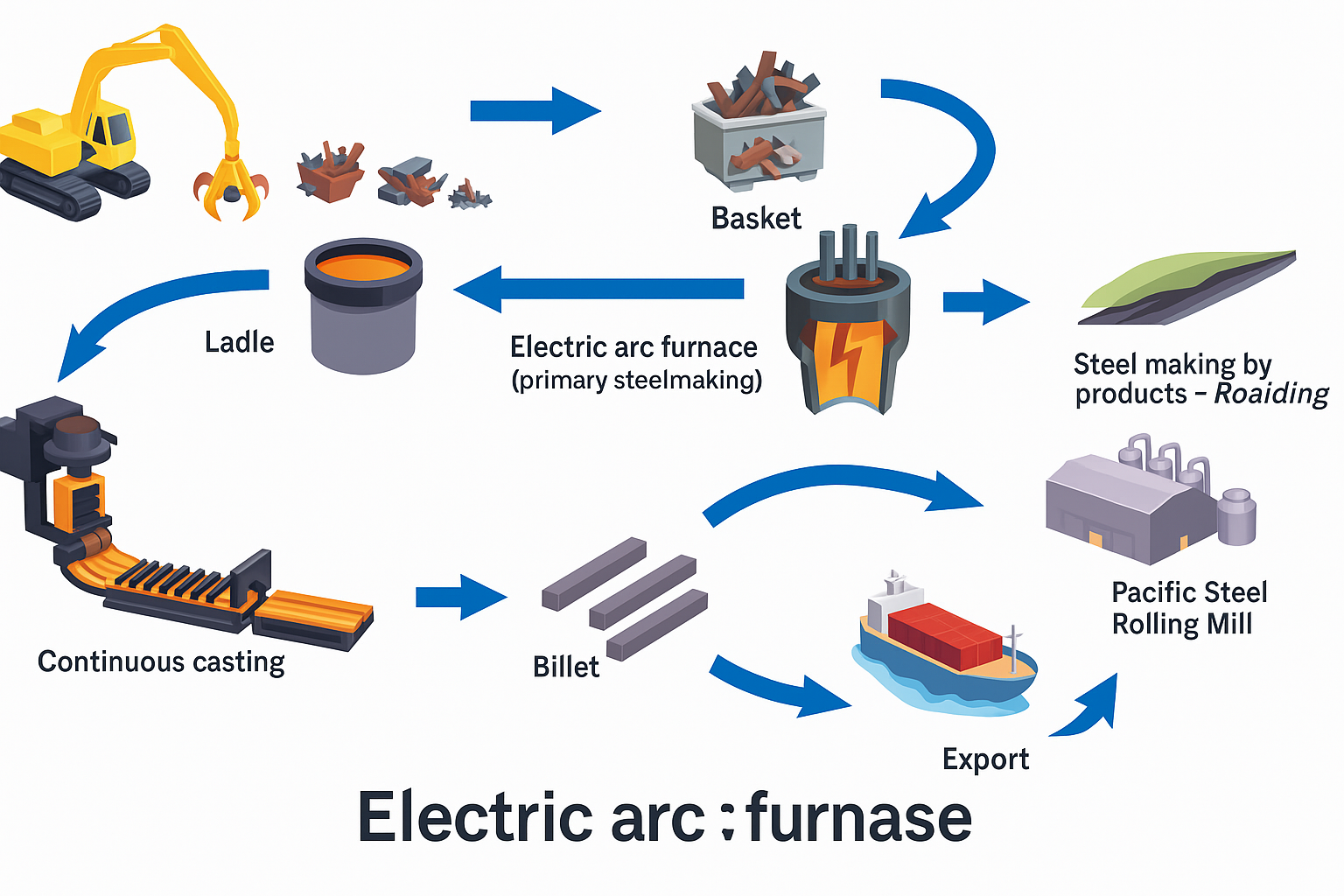
Stage 1: Scrap Collection and Preparation

Scrap Sourcing and Sorting

  • Material Recovery: Scrap is collected from local sources, including industrial sites, automotive yards, and demolition projects.
  • Segregation by Type: Scrap is sorted based on metal type (ferrous/non-ferrous), size, and composition to ensure consistency in furnace charging.
  • Preparation for Charging: The sorted scrap is loaded into large charging baskets—three in total—using heavy-duty cranes.

Charging the Furnace

  • Batch Loading System: Each batch consists of ~50 tons of scrap, distributed across three baskets.
  • Weight Distribution: The first basket carries the largest portion (20+ tons), followed by sequential additions of the second and third baskets.

Stage 2: Electric Arc Furnace (EAF) Melting

Melting Cycle

  • Initial Charge: The first basket is charged into the electric arc furnace, where high-voltage electricity arcs generate intense heat.
  • Chemical Assistance: Fluxes and chemicals are added to aid melting and initiate impurity separation.
  • Sequential Charging: As the scrap melts down, the second and third baskets are added to maximize furnace capacity.

Thermal Management

  • Energy Input: Melting requires precise energy calibration to avoid losses or over-melting.
  • Real-Time Monitoring: Furnace temperature and melt composition are constantly tracked to maintain process control.

Stage 3: Molten Steel Cleaning and Slag Removal

Chemical Refinement

  • Oxygen Blowing: Oxygen is blown into the molten steel to oxidize and remove carbon and other unwanted elements.
  • Slag Formation: Impurities react with added fluxes to form a layer of slag that rises to the top.

Slag Skimming and Utilization

  • Slag Removal: The slag is skimmed off the molten steel surface using mechanical rakes.
  • Byproduct Reuse: This slag is repurposed for use in road construction, ensuring zero waste.

Stage 4: Secondary Metallurgy and Ladle Treatment

Temperature Optimization

  • Target Temperature: Once the molten steel reaches ~1620°C, it is ready for transfer.
  • Transfer to Ladle: The steel is poured into a ladle, a heat-resistant container for alloying and refining.

Alloy Additions and Purification

  • Ingredient Blending: Key alloying elements like lime, silicon, manganese, carbon, and sometimes vanadium are added.
  • Argon Stirring: Inert gases are bubbled through the ladle to homogenize the mixture and remove dissolved gases.
  • Final Deslagging: A secondary round of slag removal ensures maximum steel purity.

Stage 5: Continuous Casting into Steel Billets

Controlled Pouring and Molding
  • Tundish System: Molten steel is poured from the ladle into a tundish that distributes it evenly to molds.
  • Mold Entry: The liquid steel flows into water-cooled copper molds, forming the basic rectangular billet shape.
Solidification and Cutting
  • Continuous Casting Machine: As the steel travels through the casting line, it solidifies from the outer layer inward.
  • Torch Cutting: Solid billets are automatically cut into specified lengths as per downstream rolling requirements.
Cooling and Handling
  • Runout Table: Newly formed billets are transferred to a cooling table to stabilize their structure.
  • Billet Yard Storage: After cooling, billets are stored temporarily in a designated yard, organized by grade and intended use.

Key Success Factors

Technical Precision
  • Advanced Furnace Controls: Real-time energy input and chemical balance adjustments ensure consistent melt quality.
  • Refining Techniques: Secondary metallurgy enhances steel properties by removing micro-impurities and adjusting chemical composition.
Operational Efficiency
  • Batch Sequencing: Stepwise basket charging improves melt uniformity and furnace loading efficiency.
  • Resource Utilization: Slag reuse and precise alloying reduce material waste and cost.
Environmental Impact
  • Recycling Focus: The entire process is rooted in the recycling of old metal, reducing mining demands.
  • Byproduct Management: All outputs, including slag, are either reused or treated to minimize environmental footprint.