

S.M. Wires delivers high-quality ferrous and non-ferrous wires nationwide, trusted by leading OEMs across India.

The Steel Billet Rolling Process

Overview: From Billets to Finished Steel Products

The rolling mill transforms raw steel billets into finished products like reinforcing bars and wire rod. This process involves precise heating, mechanical shaping through multiple rolling stages, and sophisticated control systems to produce 265,000 tonnes annually.

Stage 1: Billet Selection and Storage Management

Billet Yard Organization

  • Chemical Classification: All billets categorized by specific chemical properties
    • Different steel grades stored separately (carbon content, alloy composition)
    • Chemical analysis determines suitable end products
    • Traceability maintained from casting through final product
  • Strategic Storage System:
    • Billet yard acts as intermediate inventory buffer
    • Allows production scheduling flexibility
    • Enables matching billet chemistry to customer requirements
    • Provides quality control checkpoint before processing

Grade Selection Process

  • Product-Driven Selection: Rolling mill "draws down" specific billet grades
    • High-carbon billets for high-strength applications
    • Low-carbon billets for general construction use
    • Specialty alloy billets for premium products
  • Production Planning: Grade selection based on:
    • Customer orders and specifications
    • Market demand forecasting
    • Inventory optimization
    • Production scheduling efficiency

Stage 2: Reheating Operations

Gas Reheat Furnace System

  • Massive Capacity: Over 150 tonnes of billet capacity
    • Enables continuous production flow
    • Reduces heating energy per tonne through batch efficiency
    • Provides buffer for production scheduling
  • Continuous Loading Design:
    • One billet enters as another exits (fully heated)
    • Maintains steady production rhythm
    • Optimizes furnace utilization and energy efficiency
    • Eliminates production bottlenecks

Heating Process Details

  • Target Temperature: 1060°C rolling temperature
    • Specific temperature for optimal steel plasticity
    • Hot enough for easy deformation
    • Cool enough to maintain steel structure integrity
  • Heating Duration: 2-3 hours per billet
    • Ensures uniform temperature throughout billet cross-section
    • Prevents thermal stress and cracking
    • Allows for proper metallurgical preparation

Energy Efficiency Systems

  • 36 Gas Burner Configuration:
    • Distributed heating for temperature uniformity
    • Precise temperature control across furnace zones
    • Redundancy for continuous operation capability
  • Heat Recovery System:
    • Hot exhaust gas preheats incoming combustion air
    • Significantly reduces overall energy consumption
    • Environmental benefit through reduced fuel usage
    • Cost reduction through energy efficiency

Walking Beam Transport System

  • Mechanical Operation:
    • Lifting and moving mechanism
    • Entire furnace load lifted simultaneously
    • Billets moved forward one step at a time
    • Prevents billet damage during transport
    • Ensures consistent heating time for all billets
  • Automation Benefits:
    • Reduces manual handling requirements
    • Improves safety by eliminating human contact with hot billets
    • Provides precise timing control
    • Maintains production flow consistency

Stage 3: Continuous Bar Rolling Line

Three-Phase Rolling System Overview

The rolling process transforms square/rectangular billets into round bars through systematic diameter reduction and length extension.
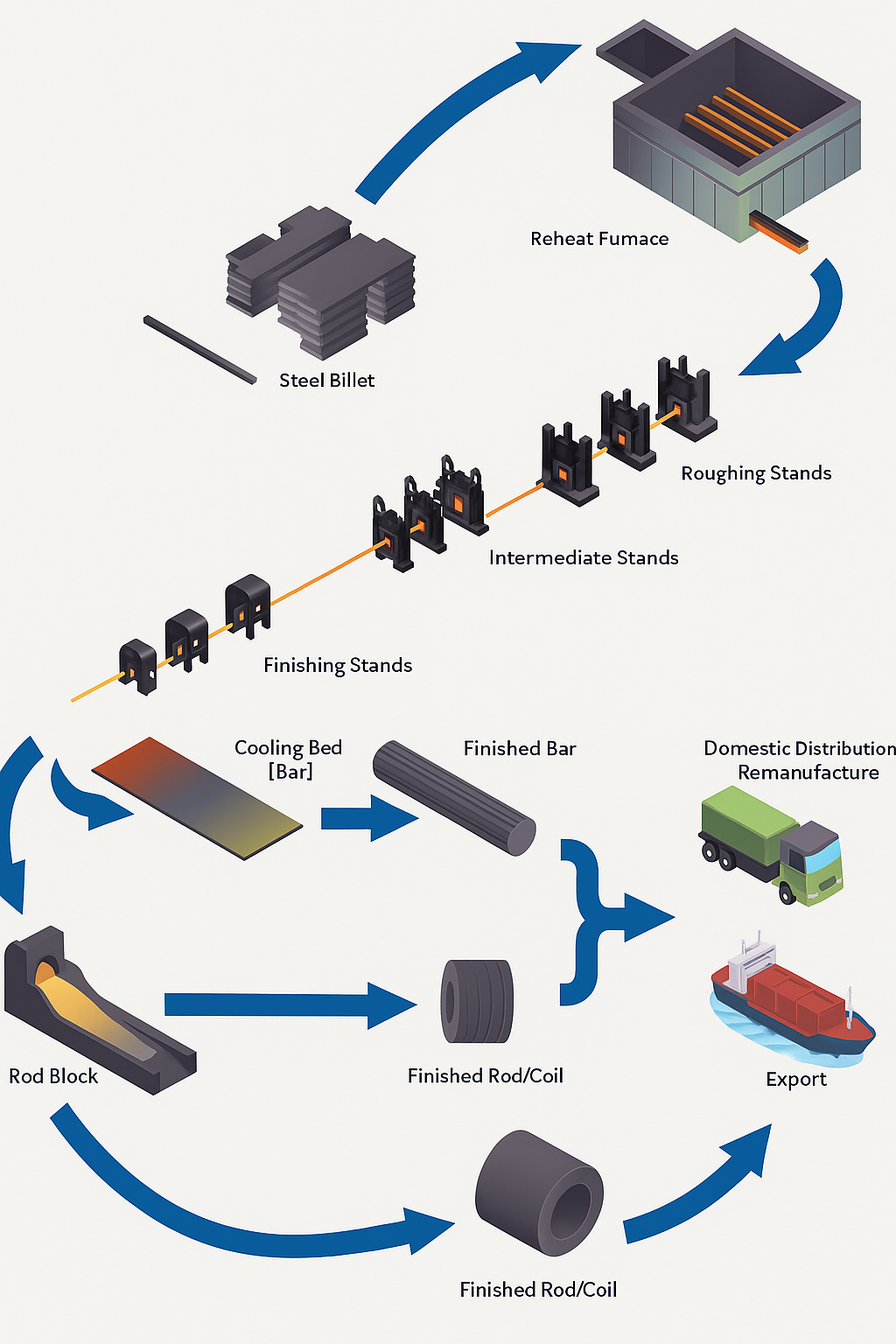
Phase 1: Roughing Stands (Preliminary Rolls)
  • Initial Shaping Purpose:
    • First major diameter reduction from billet size
    • Begins transformation from square to round cross-section
    • Establishes basic bar geometry
    • Prepares steel for intermediate processing
  • Heavy Reduction Work:
    • Largest diameter changes occur here
    • Significant force required for initial deformation
    • Multiple passes through roughing stands
    • Steel temperature still very high for easy working
Phase 2: Intermediate Stands
  • Refinement Process:
    • Further reduces diameter toward final size
    • Transforms cross-section to more oval shape
    • Prepares for final precise shaping
    • Maintains proper steel temperature for working
  • Quality Development:
    • Improves surface finish from rough stage
    • Better dimensional control than roughing
    • Prepares steel metallurgy for final properties
    • Reduces internal stresses from initial heavy working
Phase 3: Finishing Stands
  • Final Shaping Operations:
    • Achieves exact final diameter specifications
    • Creates required surface deformation patterns (for rebar)
    • Establishes final cross-sectional shape
    • Ensures dimensional accuracy and surface quality
  • Quality Control Functions:
    • Precise size control within tight tolerances
    • Surface texture creation for bonding (rebar ribs)
    • Final metallurgical property development
    • Preparation for downstream processing

Rolling Physics and Mechanics

  • Up to 17 Roll Sets: Progressive diameter reduction
    • Each roll set reduces diameter by specific amount
    • Gradual reduction prevents steel defects
    • Maintains proper steel temperature throughout process
    • Ensures uniform material properties
  • Speed Acceleration Phenomenon:
    • Steel accelerates as cross-sectional area decreases
    • Length increases as diameter reduces (volume conservation)
    • "Like rolling out pastry" - same principle applies
    • Creates dramatic visual effect with glowing steel
  • Technical Design Considerations:
    • Each roll designed for specific reduction ratio
    • Considers steel behavior under deformation
    • Accounts for equipment limitations and capabilities
    • Optimizes for both quality and production efficiency

Stage 4: Product Finishing - Two Distinct Paths

Path A: Straight Reinforcing Bar Production
  • Cooling Bed System:
    • Allows controlled cooling of hot rolled bars
    • Provides space for bars to reach manageable temperature
    • Maintains straightness during cooling process
    • Prepares for final cutting and bundling
  • Flying Shear Operation:
    • Bar cut to length as it enters cooling bed
    • Ensures each bar fits properly on cooling bed
    • Maintains production flow without stopping
    • Precise length control for bed management
  • Cold Shear Processing:
    • Performed after cooling to manageable temperature
    • Cut to exact customer-specified lengths
    • Precision cutting for dimensional accuracy
    • Prepares for final packaging and shipping
  • Bundling and Identification:
    • Bars bundled together for handling efficiency
    • Labeled with unique identification
    • Traceability maintained through production chain
    • Quality certification attached to each bundle

Path B: Wire Rod and Coiled Reinforcing Bar
  • Rod Block Processing:
    • Additional 10 sets of rolls for final size reduction
    • Extremely high processing speeds required
    • Achieves smaller diameters for wire rod applications
    • Prepares for coiling operations
  • Extreme Speed Processing:
    • Finished product travels at 100 m/s (360 km/hr)
    • Requires sophisticated control systems
    • Safety systems absolutely critical at these speeds
    • Precision engineering required for stable operation
  • Coil Formation and Handling:
    • Product spun into coil form while hot
    • Delivered onto cooling conveyor system
    • Controlled coiling to prevent tangles or defects
    • Maintains proper coil formation geometry
  • Coil Processing Station:
    • Coil drops onto forming device
    • Holds coil shape during processing
    • Prepares for strapping and identification
    • Ensures proper coil geometry for shipping
  • Strapping and Identification:
    • Coils secured with metal strapping
    • Labeled with product identification
    • Quality certification and traceability information
    • Prepared for customer delivery

Stage 5: Process Control and Automation

Control Tower Operations
  • Centralized Command Center:
    • Single point of control for entire rolling process
    • Provides complete visibility of all operations
    • Integrates all process control systems
    • Enables rapid response to process variations
  • Operator Responsibilities:
    • Monitor reheat furnace operations
    • Control rolling line parameters
    • Manage rod block or cooling bed operations
    • Coordinate overall production flow

Advanced Automation Systems
  • Programmable Logic Controllers (PLCs):
    • Each product has specific control program
    • Parameters downloaded for each production run
    • Automated control of mill equipment
    • Consistent process execution
  • Integrated Control Philosophy:
    • Automated systems provide baseline control
    • Operator oversight for quality and safety
    • Feedback systems provide real-time information
    • Human judgment supplements automated decisions

Process Monitoring and Response

  • Multi-Sensory Feedback:
    • Automated sensor data
    • Operator visual inspection
    • Experience-based decision making
    • Rapid response to process deviations
  • Quality Assurance Integration:
    • Continuous monitoring throughout process
    • Real-time adjustments for quality maintenance
    • Prevention of defects before they occur
    • Consistent product quality achievement

Stage 6: Process Challenges and Continuous Improvement

Cobble Management
  • Definition and Impact:
    • "Cobble" occurs when material doesn't flow properly
    • Can cause production stoppages
    • Potential safety hazard
    • Quality and efficiency impact
  • Root Causes:
    • Equipment malfunction or wear
    • Process parameter deviations
    • Material property variations
    • Operator error or system failure
  • Prevention Strategies:
    • Continuous process improvement initiatives
    • Equipment maintenance and monitoring
    • Operator training and skill development
    • System redundancy and fail-safes

Quality Control Systems
  • Continuous Monitoring:
    • Real-time process parameter tracking
    • Statistical process control implementation
    • Preventive quality management
    • Customer specification compliance
  • Improvement Culture:
    • Mill staff focus on cobble reduction
    • Process optimization initiatives
    • Equipment reliability improvements
    • Operational excellence programs

Stage 7: Production Capacity and Market Distribution

Annual Production Capacity
  • Volume Output: 265,000 tonnes per year
    • Reinforcing bar production
    • Wire rod manufacturing
    • Consistent year-round operation
    • Scalable production capability
Market Distribution Strategy
  • Domestic Market (55-58%):
    • New Zealand construction industry supply
    • Infrastructure development projects
    • Residential and commercial construction
    • Local customer relationship management
  • Export Market (42-45%):
    • Offshore steel market supply
    • International quality standards compliance
    • Foreign currency revenue generation
    • Global market diversification
Market Flexibility
  • Adaptive Production:
    • Domestic sales volume fluctuations accommodated
    • Export market balances domestic demand variations
    • Production scheduling flexibility
    • Customer demand responsiveness
  • Economic Benefits:
    • Stable revenue through market diversification
    • Currency hedging through export sales
    • Local employment stability
    • National economic contribution
Key Success Factors
  • Technical Excellence:
    • Precision Engineering: Advanced control systems ensure consistent quality
    • Process Integration: Seamless flow from reheating through finishing
    • Automation Balance: Optimal combination of automated and manual control
    • Continuous Improvement: Ongoing process optimization and problem-solving
  • Operational Efficiency:
    • Energy Management: Heat recovery systems reduce environmental impact
    • Production Flow: Continuous processing minimizes bottlenecks
    • Quality Systems: Integrated quality control throughout process
    • Safety Focus: High-speed operations with comprehensive safety systems
  • Market Success:
    • Product Flexibility: Can produce various bar sizes and wire rod
    • Quality Reputation: Consistent products meet international standards
    • Market Diversification: Balanced domestic and export sales
    • Customer Service: Responsive to specific customer requirements